
LNG in the News Again
May 17, 2013 § 3 Comments
The DOE announced today approval of another LNG export permit. The story linked here points out that FERC approval is still pending. It also expresses surprise that this announcement came a day or so after Secretary Moniz was confirmed unanimously in the Senate. The comment suggests that they would have expected Moniz to settle in before making the decision. The cynic in me says they waited until after the confirmation before posting the decision so as not to lose any votes. Also, the suggestion that Moniz, while at MIT, was not completely clued into the LNG debate is laughable.
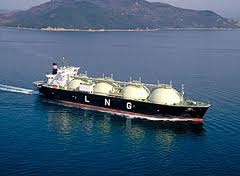
The usual people are predicting the beginning of the end of cheap gas. Let’s do the arithmetic. The Cheniere permit plus this one brings the permitted export to 3.5 billion cubic feet (bcf) per day. Compare that to the current consumption of about 68 bcf per day. This is around 5%. This is material, but is not going to change the price. For one, the country already has shut in capacity that likely exceeds that. Certainly hardly anyone is drilling for dry gas now. The eastern Pennsylvania and Haynesville bust towns will attest to that. From the day you decide to do it, gas production is possible in as few as 21 days. But, figure on it being 90 days. Compare that to the fact that no new gas will be needed till at least 2015 (Cheniere) and 2017 for the newly permitted outfit.
Expect for sure that gas required for these two permits, when needed, will more than adequately be supplied by existing shut in facilities, possibly augmented by new wells. One of the features of shale gas that is so unusual is that the spigot can be switched on so quickly. With conventional offshore gas that would have taken five years.
This aspect of shale gas, that it can be produced on demand, is what bothers the Sierra Club and other opponents. They may even be concerned that a rush to produce more may cut corners. There is merit to this last point. However, after some laxity, most states, including ours, are putting down stringent regulations. Much of the problem in Pennsylvania can be attributed to inadequate regulation and the unpreparedness of the small operators, and the communities, for that matter. Waste water was sent to municipal treatment facilities with the best of intentions. They were simply not suited to handle it. We know that now.
I believe that due to the lag time to actual operation of LNG plants, permitting of up to 10 bcf per day will be benign. The suppliers will have plenty of time to fill the gap. Also, by that time most regulations assuring sustainable production will be in and functioning. The US EPA regulation requiring zero fugitive methane emissions at well sites by 2015 will be in place. The technologies for handling these small volumes of gas will also have time to be developed.
The protestations of chemical manufacturing entities such as Dow, as reported in the cited piece, aside, there is no question that cheap natural gas is causing a renaissance in US industry today. Many industries in Europe and Asia will simply not be able to compete with US companies. They will be forced to invest here. This will be good for us. More jobs and more economic growth. Consequently, LNG exports permits ought to be carefully considered to not squander this incredible advantage. Then there is the Alaska wild card of which I wrote recently.
LNG exports are a good thing if we do it smartly.
Vikram Rao
LNG Exports: the Alaska Wild Card
May 13, 2013 § 4 Comments
The President has another of his no-win decisions on his desk. If he says yes to Liquefied Natural Gas (LNG) exports he will be seen as caving to ExxonMobil. If he says no, he will be accused of pandering to the liberals. He could pull a Solomon and split the baby, although in this case actually do it: approve limited export. A recent AP story goes into the likely options. But nobody mentions Alaska. One wonders if they are unaware of the wild card that Alaska represents in this debate. More on that below.
LNG in the US has had an incredible five years. Around 2008 we fully expected to import large quantities of LNG and eleven re-gas terminals were permitted and in various stages of construction. Today we are debating being allowed to export the stuff. All this is, of course, due to shale gas driven abundance. This causal connection is what prompts environmentalist push back. Curiously, their bedfellows in this one are folks like Dow Chemical who currently enjoy an enduring competitive advantage against most of the world in chemicals derived from gas.
Unfettered LNG exports would certainly raise domestic gas prices. The permit to Cheniere Energy, already granted, is for 2 billion cubic feet (bcf) per day. This translates to about 700 bcf per year, against our current consumption of 25,000 bcf per year. So it is unlikely to have an impact on the price of gas. In fact up to about 10 bcf per day should prove pretty benign, particularly because production could pick up. This is precisely what bothers the folks who believe shale gas cannot be produced safely. However, a lot of the initial pick up will be in the dry gas wells that have already been drilled and shut in. Less new drilling. But none of this will happen for a while. LNG plants take up to 6 years to build, so there will be no quick relief to the beleaguered dry gas owners. Owners of import terminals do have an advantage on timing. The deep water berthing of the massive vessels, the containment tanks and piping, all these can be used. In fact such sites will have significantly lower new investment and the build time could be shortened by a couple of years.
LNG exporters, by definition, rely on the raw gas being cheap. This is why so much of it comes from Iran and Qatar. The liquefaction and re-gas adds up to about $3.50 per MMBTU and can be a bit more. Transport adds between $0.50 to 1.50 depending on distance. So, from the Gulf of Mexico the landed price in Asia would be the domestic price, say $4 plus about $5, maybe a bit more because of the long voyage around South America. If the Panama Canal widening does happen, the voyage would be shorter but there would be fees. Still, after all that, one could expect a landed cost of around $10 against a price of $17 or so. Hence the excitement, even if the US prices went up some.
There is also a political dimension. Relations with Japan would be strengthened if we guaranteed supply. Since the Fukushima Daiichi disaster they are incredibly reliant on LNG.

Alaska the Wild Card: Unnoticed in this debate is the role Alaska can play in all of this. Alaska has vast reserves of natural gas that are well and truly stranded from the Lower 48. The contemplated pipeline is on life support and ought to be allowed to die. They are forced to re-inject gas associated with oil production, to the tune of 8 bcf per day. If they were allowed to export this as LNG, there would be no material impact on US pricing because it never was on the market. Note that this would be four plants of the size of Cheniere. In fact an even higher rate would have no effect on our pricing absent a pipeline. All of this gas is produced from conventional reservoirs. The Sierra Club, the most vociferous opponent of exporting LNG, should have no beef with this because it would not increase shale gas activity. The US chemical industry ought to have no concern because they would continue to enjoy cheap gas.
This would be highly competitive with exports from the Gulf of Mexico or the east coast. The shipping distance ought to be nearly half even with Panama Canal passage. The raw gas ought to be priced extremely low because it has no market value and in fact a small cost is incurred to re-inject it. This would work especially well if the gas producer were to be a partner and the gas would have internal transfer pricing. This is certainly the case with the only current LNG exporter, which is ConocoPhillips/Marathon out of Alaska today. In case you are wondering, the source for that gas would not be sufficient for expanded export. The stranded gas referred to above is up at the North Slope. A pipeline would have to be built, although much of it could likely come down alongside the existing TAPS oil pipeline.
The US should be a net exporter of LNG, but the bulk of it ought to be from Alaska.
Vikram Rao
ON PHISHING, PHOOLS AND IRRATIONAL BEHAVIOR
April 29, 2013 § Leave a comment
I had the immense pleasure last week of listening to George Akerlof give his lecture Phishing for Phools, as part of Duke University’s conference on behavioral matters. The organizers were from the D-CIDES interdisciplinary program at Duke. Aside from the unique experience of listening to a Nobel Laureate, I had a personal reason for the gratification. In my career as an engineering researcher and manager I have been strongly influenced by two non-engineer/scientists. They are George Akerlof and Adrian Slywotzky (the concept of Value Migration). I used their work directly in commercial endeavor, although likely in somewhat amateurish fashion. However, there was nothing amateurish about the bottom line financial results from so doing. A third influencer, Richard Thaler, I never had the opportunity to reduce to practice, but affects my thinking today in matters such as encouraging energy efficient behavior.

Akerlof was awarded the Nobel Prize for Economics in 2001 (together with Michael Spence and Joseph Stiglitz) essentially for the concept of Information Asymmetry. It goes something like this. If I am selling you a used car and provide all information regarding maintenance records and so forth, you will have a sense of the price you are prepared to pay. If I provide you nothing at all, you are likely to think I am trying to pass off a lemon and will devalue it. Essentially, the asymmetry of information (seller knows more than the buyer) devalues it in the eyes of the buyer.
Akerlof is generally credited with coining the term ”lemon” for a defective car in his 1970 paper that first described the concept above. The work is also credited with an impetus to make more information available to car buyers, including the use of Vehicle Identification Numbers (VIN). Also of note is that this paper, which essentially produced the Nobel Prize, was reputedly rejected by the first three journals to which it was sent! This is not unlike the reception that Stanley Prusiner got for his paper on prions, infectious proteins that now are the accepted cause of Mad Cow Disease and other cross species infection. In his case it went beyond rejection to overt denigration, when it did get published. It too resulted in the Nobel Prize, in this case for Medicine. This is the curious instance of a Nobel being awarded for the right mechanism for a disease, after another was given for the wrong explanation (Carlton Gadjucek, Nobel Prize for Medicine, 1976) much earlier!
Akerlof defined a phool as a person who is an informed person but still makes an error in judgment. He explains the recent recession as occurring because phools were misled by highly rated derivatives. The ratings agencies could not possibly evaluate the mortgages underlying the derivatives but gave them high ratings nevertheless. He ascribes this to greed. One wonders whether there was an element of sheer arrogance: their sterling reputations demanded that they have the expertise to do so, and so they did. He reminded us that economists rely on the belief that people are rational and always act in their own best interests. But phools may believe they are acting rationally and in fact are not. He believes that there are folks out there phishing for these phools. Phishing here is used in the broader context of profiting from the gullible. Akerlof has a book in the writing entitled Phishing for Phools.
One other paper at the D-CIDES conference was very interesting. It was by Rick Larrick and co-authors and soon to be published in the Proceedings of the National Academy of Sciences. We have discussed his other work previously in this blog. It demonstrated that consumer choice was affected by the labeling information, in this case on compact fluorescent bulbs. In a laboratory study with real money and technology, conservative and liberal subjects purchased CFLs at the same rate when the economic benefits alone were emphasized, but if a “Protect the Environment” label also appeared with the CFL, moderates and conservatives became significantly less likely to purchase the CFL. I will post the paper when it is published. You may remember the Cialdini experiment from a previous blog post of mine. One wonders whether a segmentation of the subjects may have yielded different results.
The original work by Richard Thaler and Laureate Daniel Kahneman is now being built upon by a number of people, chipping away at this original belief by economists, that people act rationally and in their own best interests. Duke’s Dan Ariely has a body of work here. The social science of why people make the decisions they do will be crucial to the adoption of environmentally responsible practices. This will run the gamut from using less energy for the same level of gratification to the substitution of oil derivatives with more benign alternatives.
Vikram Rao
FEEDING OUR OIL HABIT: HARD CHOICES
February 10, 2013 § 9 Comments
The Keystone XL pipeline hangs in the balance on the President’s desk. Opposition to it is the cause du jour of the Sierra Club and certain celebrities. The Sundance Kid has an op ed in a recent Huff Post railing against the “dirty oil” from Canada. So, how dirty is Canadian oil and what are the alternatives? I think we all recognize the reality that displacement of oil based fuel is going to be incremental. So we are going to have to make choices regarding the sources of our oil.

The top four sources for our foreign oil are Canada, Venezuela, Saudi Arabia and Mexico. Most of the oil from all but Saudi Arabia is classified as heavy oil. Even Saudi oil is starting to get heavier. The term heavy is used for the fact that the oil has a greater proportion of large molecules. As the molecule gets larger, the relative proportion of carbon by weight compared to hydrogen is higher. When such oil is refined, the long chains are broken down thermally and hydrogen added. This process is known as hydrothermal cracking. For particularly heavy oil a carbonaceous residue is left known as petroleum coke.
The charge of “dirty oil” leveled against Canadian oil is based primarily upon the fact that the petroleum coke, if utilized, releases carbon dioxide. Clearly a processed light oil such as the shale oil from the Bakken or Eagle Ford has very little of this residue and so is clean in comparison. But petroleum coke is in fact quite comparable to coal. The energy content is generally a good deal higher than most grades of coal and the ash content is much lower. But it usually is worse on sulfur content. For workhorse applications such as cement kilns that is of little consequence because of the presence of agents that capture the sulfur. Petroleum coke also has significant quantities of heavy metals nickel and vanadium. This almost all ends up in the ash in a form that is essentially not leachable by water. Nevertheless, this too is another reason for the “dirty” appellation.
In the event of a spill heavy oil biodegrades more slowly. This is in part because oil eating bacteria prefer the smaller morsels of the light constituents. On the other hand it will not leach into the soil as readily because of the viscosity. This notwithstanding, the originally proposed route for the Keystone XL was ill conceived. It went through a portion of Nebraska where the sediment was very porous, and this overlaid the Ogallala, the most important aquifer of the region. The proposed new route is longer (see red portion on map), but avoids the potential for aquifer contamination.
A little discussed fact is that the pipeline will also carry some of the light oil from the Bakken shale oil fields in North Dakota and possibly Montana. This important new source of light oil is currently being transported by truck and rail, increasingly the latter. Both of these forms, especially trucks in the northern climates, would appear to be more spill prone than pipelines. Besides, absent a pipeline the Bakken oil will likely be limited in production, which is not good news for domestic output.
Consider the scenario of the Keystone XL not being permitted. The Gulf Coast refineries have expensive equipment known as cokers, specially designed to handle heavy oil. If Canadian oil is curtailed they will source heavy oil elsewhere. The best bet is Venezuela, already a source. The carbon loading of this oil is very similar to that from Canada. Furthermore, the nickel and vanadium concentrations are three to four times greater. Trading Canadian partnership for dependency on a country with leadership unfriendly to US interests sure sounds addled.
Finally, consider the question: can Canadian crude be cleaned up before it comes to us? The answer is yes. The simplest way to accomplish this is to remove much of the excess carbon prior to shipping using a technique known as de-asphalting. When propane, hexane or a combination are added to heavy oil, they pick up the lighter component of the crude and the carbon heavy asphaltene drops out as a solid. The extracting liquid can be regenerated for re-use and the so called de-asphalted oil (DAO) can be sent down to us. A bonus: much of the sulfur and most of the heavy metals preferentially segregate to the asphaltene, so the DAO is lower in these elements as well.
Our refiners currently get Canadian crude at a heavy discount. The DAO will likely command a better price. The cokers will be underutilized because the oil is cleaner. But the country will be the better for it.
Vikram Rao
ENERGY, AGRICULTURE AND THE ENVIRONMENT
January 8, 2013 § 2 Comments
The title brings immediately to mind energy from biomass. While that is a perfectly reasonable thought we ought to consider the other angle, that of energy use in agriculture. Water intensity of agriculture is one of its hallmarks. In the US roughly 31% of water withdrawals are for this purpose. The vast majority of withdrawals require the use of pumps. This is because Artesian wells, which are naturally pressured, are in a minority.

According to a World Bank study, the economic status of the farmer determines the type of energy used in farming operations. Human effort is progressively replaced by animals such as bullocks. The next step up the economic ladder causes the use of pumps powered by fossil fuel, usually diesel or kerosene. The use of wind, which goes back centuries, is still nascent.
The ever increasing economic status in the developing world would therefore point to greater use of fossil fuel for lifting water and for tilling and harvesting. In response to this virtual certainty, two options are available. One is a shift to wind or solar. In the consideration of these alternatives, the economic parity required may be with very expensive fossil fuel. In India much of the diesel for this purpose is heavily subsidized and so the apparent cost may not be high. But the real cost to society is high in the tax burden of subsidies and cost of transportation in trucks over long distances. Furthermore, hybrid systems could be considered where the wind power produces electricity when not pumping.
The other solution is to produce diesel substitutes locally. At RTEC and RTI this year we will be making a major push on the concept of small footprint production of fuels and chemicals from natural gas and biomass. The scale would be about a hundred times smaller than conventional refineries and chemical plants and the targeted economics of production would be comparable or lower than with large plants. This flies in the face of current dogma on economies of scale but is feasible with exceptional innovation. Each farming community would be supplied locally, using the raw material of convenience. This would be natural gas, methane from refuse and waste, or biomass in the form of waste cellulose (stalks of plants and so forth) or woody biomass. The fuel produced could be diesel, methanol or di-methyl ether, all of which would function in pumps, tractors and cook stoves.
Chemical fertilizers are also energy intensive and farming increasingly relies on these. The dominant feed stock for these is natural gas. Potash, a source of the nutrient potassium, is mined and processed, also using much energy. Reduced reliance on fertilizer is a tough but worthy target. These chemicals are also amenable to smaller footprint production, but likely not as dramatic as for transport fuel.
Increasing per capita GDP is also strongly correlated with more meat in the diet. It appears that this is a sociological response similar to the escalation in ownership from scooters and motorcycle to cars. Meat is decidedly less energy efficient than a vegetarian alternative. This is especially so as practiced in the west, where corn and soy beans are used as feed in place of forage. But the bigger environmental factor may be the inefficiency of the rumen in animals such as cattle. That results in the production of methane, which in many countries such as the US is one of the top contributors to greenhouse gases. The solution likely lies in two areas. One would be selection of the more efficient breeds, but on a large scale this could be tough. The other is additions to diet to improve conversion. Researchers in Canada and France have already reported some success with enriching feed with certain lipids. Some believe that addressing the meat eating increase could rapidly become the highest priority element of the imperative to feed a burgeoning world population.
Finally, there is the whole issue of producing energy from plant matter. Congress appears to be on track to retain subsidies of about $1 a gallon on cellulosic ethanol. This is a tough techno-economic nut to crack so deserves an assist till it gets going. But as we have discussed before, methanol could be produced economically from biomass with no subsidies for the fuel. That is the reasonable course especially this year when cliff avoidance compromises have left the country with a greater burden on deficits.
Vikram Rao
SHOULD WE EXPORT HYDROCARBONS?
November 30, 2012 § 4 Comments
Two senators recently weighed in on this issue at a Hill Policy Breakfast, Natural Gas and Energy Issues in the New Congress, sponsored by the American Natural Gas Alliance. This organization name, abbreviated to ANGA, unfortunately, or perhaps deliberately, sounds like anger. Not surprisingly the senators selected to speak, each from one side of the aisle, were largely pro-industry and yet balanced. It was personally gratifying that both were women, Lisa Murkowski of Alaska and Mary Landrieu of Louisiana.

Just about all of the discussion centered on the advisability of exporting liquefied natural gas (LNG). Murkowski was more strongly in favor with a bit of a caution on what it could do to domestic prices. Landrieu was openly conflicted because her constituents were major producers and users. Both were looking forward to the long awaited decision from the administration.
A representative from Dominion Oil, an applicant for LNG export, asked Murkowski whether rules may get made allowing Alaskan gas export but not in the Lower 48. She essentially said it would not go down that way, possibly in an effort to not sound partisan. Both senators gave the distinct impression of serving the nation not just their constituency. This was refreshing given the recent history of congressional behavior.
The senator’s response notwithstanding, the idea of permitting just Alaska export is not without merit. There are two principal arguments against LNG export. One is that it could raise the price of domestic gas and thus reduce the advantage US chemical manufacturers currently enjoy with respect to European and Asian competition. The other is that it makes more sense to convert the gas into chemicals and fuels and export those items. The spread between the raw material price and the finished goods is so great that it just makes economic sense to export the high value items not the raw commodity. That also results in the manufacturing jobs being retained in this country.
On the first point, there is considerable head room in the competitive advantage for US chemical manufacturers. Today European prices are up to three times those in the US and Far East prices are as much as five times. So even if LNG exports raised prices the US advantage would remain, albeit less strikingly. Modeling could identify the upper limits of LNG exports to minimize the effect. Natural gas pricing in the vicinity of $5 per MM BTU would be good for consumers and producers. One could also make the point that at prices today under $4, dry gas prospects (those without appreciable high value natural gas liquids) are essentially uneconomical. LNG needs dry gas and would constitute a robust destination for the commodity especially from currently distressed areas such as the Haynesville. The fly in that particular ointment is that LNG plants take up to four years to construct and commission. By that time other factors may advantage dry gas, such as methanol production in expansions of current capacity, displacement of coal for electricity production, use in transportation and so on.
The case for Alaska is different. This is a situation where the gas is stranded with no destination especially now that the long debated gas pipeline to the Lower 48 makes no sense at all. Since it is not a part of the supply equation, export from that source ought to have zero impact on N American pricing. So, while the likes of Dominion may consider it unfair to single out that source, purely on the basis of national economics it makes sense. As mentioned in my book, the preferred solution is to convert it into liquids and slug it down the Trans-Alaska Pipeline, which is running dangerously low in capacity. But the LNG solution could find support. The logical destination would be the Far East where the landed price is the highest in the world and so margins for the producer may well be better than for the liquids solution. High prices in Japan may be sustained if the opposition to nuclear energy remains strong.
With respect to the other argument against LNG export, the US manufacture of high value products, the factor in favor is that many of these products are currently imported. Principal among them is ammonia fertilizer, with imports accounting for nearly half the consumption. The spread is also large; at current gas prices, it can be produced for well under $100 per metric ton, with selling prices north of $600. The prospect of the US becoming a net exporter is not at all farfetched.
Vikram Rao
SMALLER IS BETTER
November 27, 2012 § 3 Comments
We are much more used to the adage “bigger is better” in most things other than carbon footprints and runway models. And in the case of the latter the operative term is more correctly slimmer as memorialized by the symbolism and actuality of Twiggy. My enduring memory of arriving in this country in the late sixties is being struck by the fact that everything was large. Toothpaste came in regular, large and economy sizes. But marketing and consumer preferences aside, most industrial enterprises have always profited from scale. “Economies of Scale” is firmly embedded in the engineering lexicon. Which begs the question: when is this valid and when is it a hindrance?

In some ways it was Henry Ford who most popularized the notion. An assembly line dropped the cost per unit, in his case for cars. But it applies as well to any enterprise with high fixed costs, which now get spread over more units. But for our discussion we will focus on process economics. The standard power generating plant in the early part of the last century was in the vicinity of 30 MW (megawatts). By the end of the century it was 1000 MW. Some of this came about because the processes were designed to take advantage of economies of scale. In fact, most chemical and metallurgical processes are designed with this as a feature. Seldom will we find oil refineries smaller than 100,000 barrels per day (bpd). The plants converting natural gas to transport liquids are even larger. A counter example in power generation is windmills, which are small by design (3 MW or so).
This reliance on very large production plants has driven the business models. Oil is lifted out of the ground and sent vast distances to be refined into useful products. When oil used to be light, this transport was not onerous because such oil flowed relatively easily. However, oil produced today is increasingly heavier, especially the stuff from Canada, Venezuela and Mexico, three of the top four foreign sources for the US. Heavy oil is very viscous and does not flow without the addition of a light hydrocarbon, known as a diluent. The diluent is recovered at the refinery and reused. But all this adds cost. Ironically the largest pipeline transport distances are those for heavy oil from Canada. This extreme reliance by Canada on US refineries is what created the political football of the Keystone XL pipeline addition in this last election. But large refineries are likely here to stay.
Natural gas processing, on the other hand, could be amenable to innovation. The explosion of shale gas production and the continued ramp up allows one to consider alternatives. This is because pipeline infrastructure is inadequate and will need to be installed. If technologies are developed that economically produce derivatives closer to the source of production, then several benefits accrue. Manufacturing jobs will now be distributed across the country, not just in the Gulf Coast. Today nearly 80% of ethylene cracking capacity is in Texas and Louisiana. Ethane from east coast shale gas operations will need to be piped down over 1200 miles to be cracked.
Smaller facilities are quicker to build and easier to finance. A 100,000 bpd gas to liquids conversion facility will cost about $12 billion. A 1000 bpd unit will cost $120 million. While not pocket change, this figure is much easier to raise for investment. Lest this all sound too much like wishful thinking, several processes are currently in late stage development to produce diesel, jet fuel and methanol from natural gas on the scale mentioned. There is reason to believe that the linear reduction in cost I posted above can be beaten. In other words, the smaller unit may well produce fluid at a lower fully loaded cost than a large one. This is completely antithetical to the concept of economies of scale and is driven by breakthrough technologies that challenge design dogma.
Biomass conversion will be the area most advantaged by the sort of advance mentioned. This is because biomass tends to have very low energy density, thus making transport to distant large processing plants cumbersome and often not economic. A solution is to bring the plant to the biomass site. This is strongly facilitated if small footprint technologies are brought to bear. Interestingly, technology developed for natural gas conversion will apply directly to biomass, although some additional unique steps will be needed. But here too, technologies currently in development offer promise.
Size matters, except when it does not!
Vikram Rao
ELECTING ALCOHOL IN NORTH CAROLINA
November 12, 2012 § Leave a comment
There are some that say ethanol is for drinking not driving. Other than the clever phrasing, the origins of this aphorism are in the low calorific content of ethanol as compared to gasoline, about a third less. There is a reason that gasoline has endured for over a century as the transport fuel of choice: the energy density is high.
The country as a whole is seeking gasoline substitutes for environmental and balance of trade reasons. The North Carolina legislature laid down a target for 10% of all transport fuel to be produced in state by 2017. Biofuel was seen as the avenue and the Biofuels Center of North Carolina in Oxford took a lead in pointing the way. Here we make a case for alcohol, both ethanol and methanol, to be considered as the dominant means of achieving that objective.
Both alcohols blend with gasoline effectively. E85, a blend with 85% ethanol, is already available in many states. The methanol analog, M85, was piloted in California some years ago. Enabling either requires that cars are Flex Fuel cars, as many are today. The conversion cost is in the neighborhood of $125 when done at the original factory. Bills in Congress today on the Open Fuels Standard would require that most new vehicles by 2017 have flex fuel capabilities.
But North Carolina may not need the adoption of the high alcohol blends to meet the targets. Both ethanol and methanol at the 10% level act importantly as oxygenates. This is a property that allows a more complete burn of the fuel, which is good both for fuel economy and the environment. But even if every drop of gasoline contained state grown alcohols, the legislative target would not be met because the state uses about a third as much diesel as gasoline.
There are two potential solutions to this numbers game. One would be to simply increase the normal blend to 13% alcohol. This would account for the diesel use without even counting the increasing use of biodiesel. There are moves afoot in other states to permit an increase to 15% ethanol in gasoline.
The other measure to help with the problem would be to progressively require all diesel used in the state to contain 20 to 25% di-methyl-ether (DME). This is completely feasible without engine modifications. Furthermore, DME produces zero particulates and has a higher cetane rating, so it is an improvement over diesel in that regard. From the standpoint of production, DME is easily manufactured in a methanol plant by using a simple additional process step. So, a policy standardizing on alcohol as a gasoline substitute enables the production of a diesel substitute.
All biomass suffers from having low energy density. One solution is to process the material to be denser prior to transport. High pressure baling of cellulosic fiber and Torrefaction to produce high density pellets are two such measures. Another approach is to bring the processing facility to the source. This is particularly feasible for crops, because co-location can be planned. The recently announced Chemtex plant to produce cellulosic ethanol additionally plans to take advantage of the low cost nitrogen fertilizer available in parts of North Carolina. The source for the nutrient is hog waste stored in “lagoons”. The liquid is sprayed onto fields and provides the fertilizing action at a fraction of the cost of ammonia fertilizer, which trades for over $600 a metric ton. This underlines an interesting advantage for the state, provided all of this can be accomplished with acceptable air emissions, volatile organic compounds (VOC’s) to be specific.
Woody biomass is by far the most available biofuel raw material in NC. The lignin component is notoriously difficult to break down for ethanol production. But thermal processing to synthesis gas (syngas) is straightforward. From syngas a variety of fuels can be synthesized. Methanol is the simplest, closely followed by DME. Both of these figure prominently in our proposed course of action described above.
An alternative starting point for syngas can also be natural gas. In fact at prices today, it will be more cost effective than woody biomass. The natural gas could be produced in state or imported from a neighboring producing state. Regardless of where the raw material was sourced, the value added product would be produced in state and the jobs would be created here.
Some combination of ethanol, methanol and DME, augmented by existing biodiesel initiatives, is a viable means to achieve the legislative goal of 10% of transport fuel being produced in state by 2017. For the state that pioneered prohibition there is a mild irony in alcohol playing a legitimate role in shoring up the economy.
Vikram Rao
THE HIGH COMPRESSION GAMBIT
October 16, 2012 § 7 Comments
The foremost American electric car battery company, A123, declared bankruptcy today. A high flying MIT spinoff, honored by the President at the big house, bestowed with DOE funding to the tune of over $200 million, is on skid row. I am sure the Pundits will weigh in with what this might mean. But it certainly is a datum point that fits in with the lackadaisical sales performance of the electric cars. And it appears to offer support for what I am dubbing The High Compression Gambit by Mazda.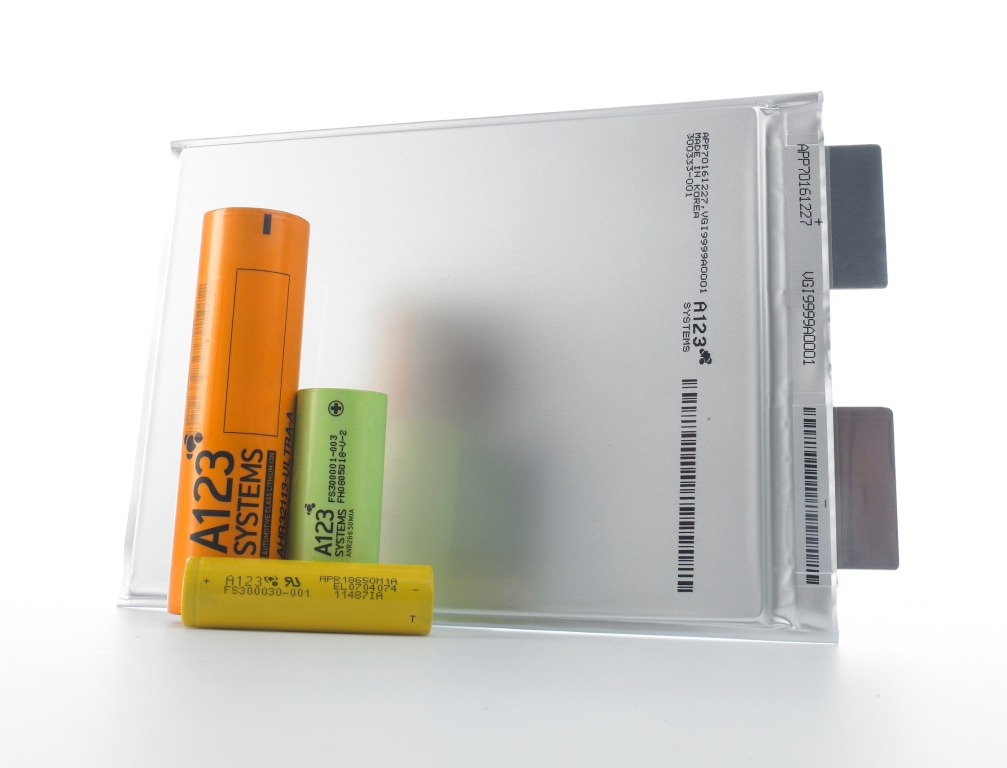
Mazda has made a few moves that signal an explicit strategy to defer electrification to the future. They have introduced a line of cars with high compression ratios operating on conventional gasoline. In my book, Shale Gas: the Promise and the Peril, I advocate the design of high compression engines to take advantage of the high octane ratings of the three viable gasoline substitutes, ethanol, methanol and methane. I suggest piloting through the armed forces, a la the Hummer. It seems as if at least one company is willing to take the plunge and not wait for anyone to lead the way.
But Mazda’s move appears to have nothing to do with enabling the gasoline alternatives. More below on how we can avail of that, no matter their intent. They were shooting for higher engine efficiencies to enable the latest CAFÉ standard to be met. Since the design started years ago, somebody was reading excellent tea leaves.
Conventional gasoline fueled cars have compression ratios (CR) of around 9:1. For a discussion of this parameter, see a previous blog. Regular gasoline experiences premature fuel ignition at higher compressions. What Mazda did was to make the cylinder narrower and longer. But the critical innovation was to provide two injections of fuel during a single cycle. The second injection is right at the point incipient knocking. The evaporative cooling drops the temperature enough to prevent premature ignition. This allowed them to increase the CR to 12:1. Fancy exhaust system management allows them to another notch up to 13:1. For 14:1 they need to use premium gasoline. They are offering this only in Europe. They believe American consumers will balk at the fuel premium, which is around 30 cents in most states.
The Mazda3, offered with just the junior version of 12:1 is reported to improve mileage from the 24/31 City/Highway to 29/39. There is some arm waving on manual versus automatic transmissions, improvements to the latter, and so on. But these are big improvements with no change in the gasoline. This appears to be the gambit. Keep improving the efficiency of the engine to help with the CAFÉ targets and kick in the electric capability when things get more viable.
We have opined in earlier blogs that electric cars, and hybrids for that matter, needed battery costs to drop to under $200/KWh and range to improve. The demise of A123 is not a promising note, but they may still be a factor. Continental Airlines went bankrupt twice before it became a value leader.
As we have noted before in these pages, improving efficiency is the fastest way to reduce emissions. The same gratification for less fuel used. I was not able to locate the predicted mileage for a Mazda3 with CR of 14:1. The benefits diminish in non-linear fashion at the higher CR’s. But it needs 95 octane gasoline.
Now for the punch line. Both E85 and M85, respectively with 85% ethanol and methanol, rest gasoline, will certainly do the job. My favorite is methanol. The evaporative cooling with M85 will be even more effective than with gasoline. In fact, compression ratios of 16 or 17 ought to be possible. Also, it is dramatically cheaper with low cost shale gas and can also be made from coal or biomass, all for lower cost than ethanol from corn. At today’s natural gas prices the cost of methanol is under 45 cents per gallon. With half the energy content of gasoline it is still much cheaper.
So, consider that at today’s regular gasoline price of $3.80, a compact car will have a fuel cost of 10.8 cents per mile (35 mpg assumed). With the same assumptions on range, M85 today will cost 5.8 cents per mile. Because of the units we are using, the energy content penalty of methanol is already counted. The consumer would have to refuel every 200 miles instead of the 350 miles assumed for the gasoline case.
For the CR 14:1 vehicle the comparison would be with premium gasoline. That would raise the cost per mile to about 11.7 cents, while the M85 would remain the same because the 15% gasoline component need only be regular gasoline.
If M85 were available, Mazda could bring the 14:1 car to this country, make the small modifications required to tolerate ethanol and methanol, and allow consumer choice. The driver could use premium gasoline or E85 or M85, whichever was available. Obviously, at the numbers shown above they would demand M85. This would set the ball rolling for the true future: some portion of passenger vehicles with CR’s of 17 running on M85 and many others with CR’s of 14 or so with fuel choice. Oil derived gasoline would be rendered just another option, a step towards reducing oil to merely a useful, not a strategic, commodity. When that happens, OPEC will be defanged as a manipulator of oil price.
Vikram Rao
US GETS A MULLIGAN IN CARBON MITIGATION
September 21, 2012 § 1 Comment
Used as we are to being accused of being extravagant users of energy, the recent report from the Energy Information Administration (EIA) is an eyebrow raiser. It states that the US carbon emissions from energy use dropped to levels not seen since twenty years ago. Before you pop the Champagne (and thus adding CO2 to the air!), these statistics are just for the first quarter of 2012. And in examining the principal factors one is forced to conclude that the country has, in golf terms, received a mulligan (thank you Tim Profeta at Duke for that characterization).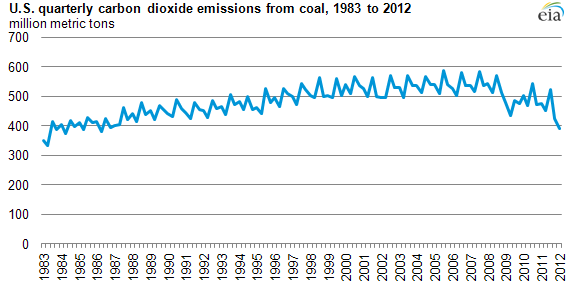
The accompanying analysis by the EIA is sparse. They ascribe three reasons. One is the warm winter and associated reduction in use of heating fuels. But these are quarter to like quarter comparisons. We have had warm winters before in the last decade. The other two reasons are more interesting from the standpoint of a go forward national policy.
Cheap shale gas driven a switch from coal to natural gas in the generation of electricity is clearly a big factor. For the oldest coal plants it was more cost effective to switch to gas rather than to retrofit pollution control equipment. To the extent this startling carbon mitigation statistic has been discussed at all, the principal attribution has been to this factor. Studies making the direct quantitative connection are not in evidence. But, the underlying assumptions regarding the near halving of CO2 from substitution of gas for coal are not disputed. Activism by Sierra Club and others continues to shut down coal plants. One could therefore reasonably expect continuation of this trend towards gas substituting for coal. New wind generation capacity can also be expected, but not as fast.
The third reason cited by the EIA is reduced consumption, largely attributed to the recessionary conditions. The concurrent high gasoline prices likely were a factor. Whatever the reasons, gasoline consumption has plummeted in the last nine months, from about 9.1 million barrels a day in June, 2011 to 8.5 in April, 2012. An improving economy ought to moderate this drop rate even if oil prices remain high.
Looking out to the next two decades, we have the federal target for a drastic improvement in the fuel efficiency of vehicles: 45.4 miles per gallon by 2025. New vehicles today average 24 mpg. This near doubling in fuel efficiency ought to have direct effect on emissions per mile driven.
But there is always Jevons’ Paradox to worry about. Jevons was an economist a century and half ago who predicted that when devices become more efficient people simply use them more, thus offsetting the efficiency improvement. Modern economists term this the rebound effect. In the automobile example, this could entail per capita miles driven to go up because the consumer would note the reduced cost per mile. To the extent that this happens, the positive effect of increased efficiency on CO2 emissions would be dampened. In a recent discussion the economist Richard Newell at Duke, who until recently headed the aforementioned EIA, opined that the rebound effect would be relatively small in this case. For most people work related miles are a principal component. This is not going to change just because the cost goes down.
But fuel economy standards apply only to new vehicles. So they will take a while to become a major factor. Earlier gains would be made through fuel substitution with less polluting alternatives. The simplest ones are natural gas vehicles for public transport and light duty vehicles. Another straightforward thrust would be substitution of up to 25% diesel with di-methyl ether (DME) without engine modifications. DME from cheap natural gas would cost much less than diesel, has zero particulate emissions and a very high cetane rating. Particulates (with associated health effects) are a less publicized target for mitigation. The deployment of DME in the diesel infrastructure could be almost immediate in the case of captive businesses such as fleets for vehicles, and compressors and pumps for all manner of industrial endeavor, including fracking for gas and oil.
While this country can take some satisfaction from the carbon mitigation statistic we cannot rest on those laurels. We may indeed have been granted a mulligan by the coordinated effects of shale gas related coal substitution and a weak economy using less energy. A tax on emissions, implicit or explicit, is not on the cards. We need policy that is industry and consumer friendly and yet effective in reducing emissions. Natural gas substitution of coal and increased proportion of renewable energy will likely continue. We need a national policy and associated research that makes deep inroads into substitution of oil based transportation fuel with less polluting domestic alternatives.
Vikram Rao
 Research Triangle Energy Consortium