
Deep Water Completions Urgently Need Innovation
January 25, 2010 § Leave a comment
The cost of completions in deep water has progressively increased to the point where it can represent over sixty percent of the total well cost. We are already to the point where this is impacting the economic prospectivity of reservoirs. While this trend is manifest in conventional deep water, it is exacerbated in deep water combined with deeply buried reservoirs such as the Paleogene, variously referred to as the Lower Tertiary. The recent exit of Devon from the sector is a signal, even though it was undoubtedly driven by a host of factors. This in one of the most critical issues facing the industry today, in part because deep water activity has to date been relatively immune to the economic travail faced by the industry. The rig count in floaters in fact went up in 2009 compared to the prior year, and some are forecasting ultra deep (defined as water depths in excess of 7000 feet) rigs to more than double in three years. The industry can ill afford a hiccup in this bastion of stable growth. We will enunciate the issues, describe the underlying factors and discuss the viability of innovations to ameliorate the problem.
Sand Management: For conventional deep water prospects this is the single most critical issue. Deep water sediments are almost always young in age, typically less than 10 million years old, and therefore relatively poorly compacted. The majority of the prolific reservoirs are in a class known as turbidites. The unusual manner in which they were formed caused each layer to have relatively uniform particles. When particles of like size are packed together it allows for good pore communication. As a result these reservoirs have high permeability, often in excess of a Darcy. However, the associated high production rates put a strain on the sand body, inducing the production of sand due to the low sand to sand grain adhesion caused by the youth of the rock. Dealing with this is the principal component in the high cost of deep water completions.
The uniform approach to handling sand production is to screen it out. Screens of varying sophistication are used to suit the occasion, but the workhorse method in deep water is a layer of gravel followed by a mesh screen, known as gravel packing. This has been the standard because by and large it performs. However, it is rig time intensive and the increasing rates for deep water rigs have contributed to the ever increasing costs of the completion. Also, the need for remediation at some point is almost certain, and for a period prior to that production rates will be impaired. Another shortcoming is that the testing methodology for determining the need for sand control is imprecise, and the resulting uncertainty causes virtually all deep water reservoirs to be gravel packed, a conservative approach that adds to the cost for the sector. We will be discussing this issue in some detail and drawing attention to a technique that improves the certainty of the measurement, thus allowing for an approach that we refer to as informed aggressiveness. Finally, we note that currently we are responding to the symptom of sand production and ameliorating it through preventing ingress. We will advocate instead treating the underlying cause of sand production with the expectation that in so doing we would be able to make do with simple screen devices, thus reducing complexity and cost. Additionally, there would be an expectation of extended production before remediation, and this too, if needed, may be accomplished with a lower cost method.
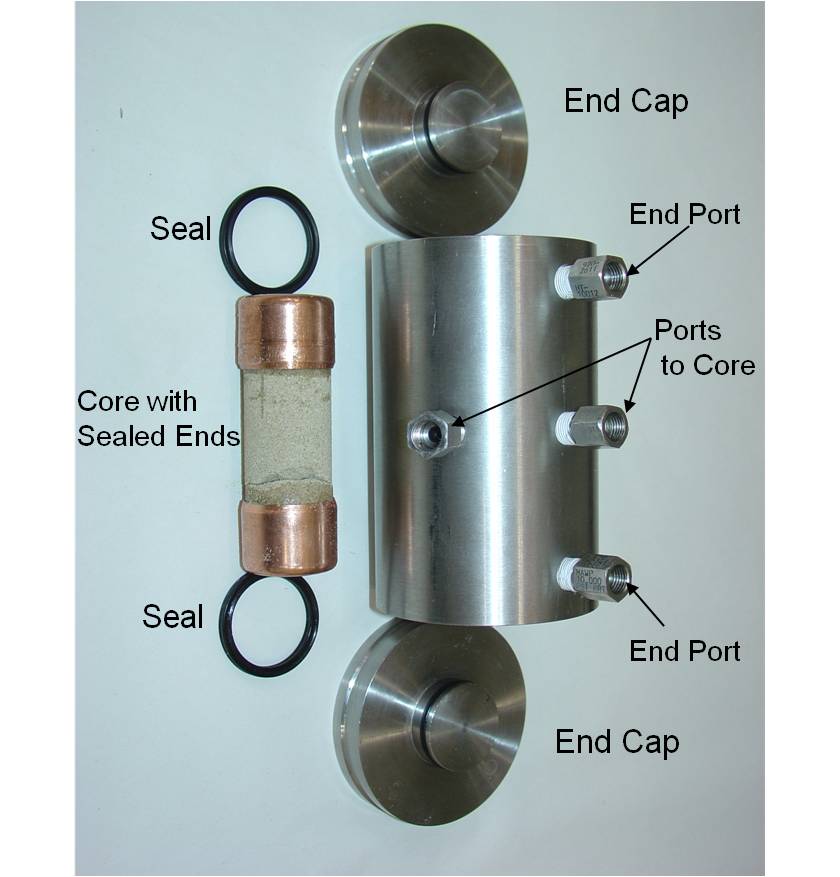
Figure 1: New test fixture designed to measure cohesion directly using internal pressure to cause the core sample to fail in tension. The fixture allows cohesion to be measured directly with different saturating fluids to observe the saturating fluid’s impact on strength
Testing for Sanding Propensity:
Cohesion of sand grains is the property that determines whether or not one could expect sand production. This property has proven elusive to estimate. Current methods utilize compressive stress/strain measurement on core, using a technique known as Mohr Circle Analysis. This has two shortcomings. First it assumes elastic behavior of the rock and we know that to be a bad assumption for young deep water rock, which has plastic and visco-plastic tendencies. Second, in rock mechanics cohesion is defined as the stress required to separate individual sand grains, and this is clearly a tensile property. Consequently, therefore, we are using a compressive test to assess a tensile property. All of this causes sufficient uncertainty in the measurement as to force the decision to gravel pack wells when this may not be required. Finally, cohesion can also change with fluid saturation; therefore any completion design should consider the effects of such events as water break through later in the life of the well. Conventional sand prediction tools do not allow for this to be included. This is largely because we cannot predict how increased water saturation will affect cohesion in the formation. All of the foregoing suggests that a new test is needed; one that more precisely assesses sand grain adhesion and one that allows for experimentally determining the effect of fluid saturation.
One such technique is shown in Figure 1. The core is subjected to internal fluid stresses designed to fail the sample in tension. This test cell allows the core samples to be exposed to downhole pressure conditions. As pressure is released from the sealed ends of the core sample, the sample is stressed in tension. In this manner, internal pressure generates the tensile force and induces the cohesive failure of the sample. The fluid properties can be changed to model expected changes in saturation later in life of the well.
Treating the Cause Not the Symptom: As discussed earlier, current methods deal with sand production as inevitable and deal with it by treating the symptom: minimizing entry into the producing bore hole with screening methods. Over time the screens clog and remediation is required, often an expensive side track of the well. A more elegant approach would be to treat the sand to improve grain to grain adhesion without compromising permeability. This has been attempted for decades using the approach of improving the bulk compressive strength to withstand fracture. This has had limited success in part due to high chemical loading, impairment of retained permeability and cost. Only recently has the thrust changed to primarily address cohesive strength, with much less emphasis on increasing
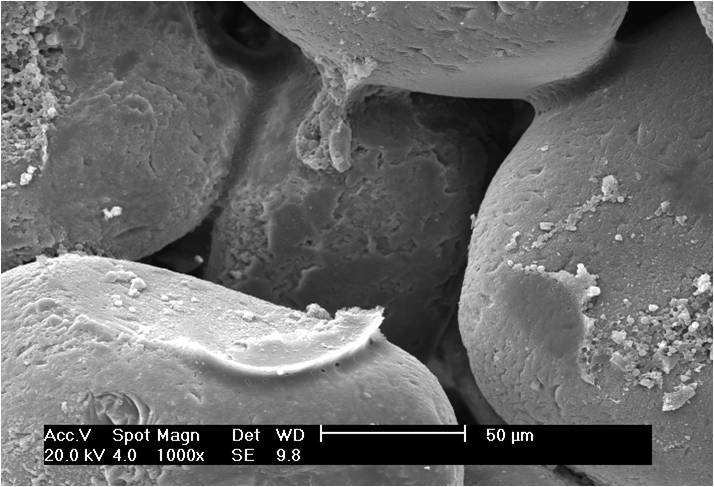
Figure 2: Scanning Electron Microscope image of formation material that has been strengthened using new placement techniques where the consolidating materials are selectively placed at the contact points leaving pore spaces open for production.
compressive strength. Part of the reasoning here is that we now believe that the primary cause of sand production is not rock fracture per se, but the detachment of individual grains from each other. The low chemical loading and the specificity of the resin in primarily gravitating to the grain to grain interface, results in the pore spaces being relatively unaffected, thus minimally impairing fluid flow characteristics. Figure 2 shows an electron micrograph demonstrating this effect. (Editing note: the figure legend will describe this more fully)
Importantly, the efficacy of the treatment can simply be tested using the new testing method, and the treatment can be optimized for various anticipated conditions of saturations, draw down and flow rates. The foregoing offers the promise of fewer wells being treated for sand control, combined with lower cost completions for those that need it. Formation strengthening, if successful, will allow for far simpler screening complements. In the limit gravel packing could be eliminated. Simplification is particularly of interest in horizontal and multi-lateral wells, both of which have advantages relative to formation exposure and reduced draw down for same production rates. When the Troll Field oil leg was drilled with Level 5 multi-laterals, the lower draw down contributed to the sand production being delayed. Such wells are very difficult to gravel pack reliably and reproducibly.
Obviously, aggressive means such as those advocated require a high degree of certainty. The testing method is a key to selecting the best treatment and assessing likely efficacy. Also, piloting in cheaper wells and in remediation of wells with plugged screens would be prudent first steps. We describe this approach as Informed Aggressiveness. Drilling programs have long used this, as for example in the handling of pore pressure/fracture gradient variability. Real time pore pressure measurement and associated modeling allows the more aggressive operator to drill closer to balance, thus vastly improving rates of penetration and minimizing formation invasion, while largely avoiding kicks and blow outs.
Dealing with Salt: The majority of the important deep water tracts in the world are overlaid by salt diapirs. These are sheets of salt, which can be from a few hundred to few thousand feet thick. When these are outcrops on land, they are often mined to produce table salt labeled rock salt. The sheets in deep water present immense difficulties to seismic exploration due to the relative imperviousness to penetration of sound waves. Here we concentrate on the effect on drilling and completion. As these layers extruded out millions of years ago, the rock below was often reduced to rubble, presenting a zone of uncertain character as the drill bit left the salt. The completion is more directly affected by the nature of the salt itself. In a sense the salt is still “live”. A hole drilled in it is subject to the mechanical phenomenon known as creep, a sustained relatively low stress, but one which could buckle the casing. Accordingly, the casings have to be unusually robust, adding to the cost.
The difficulty of imaging below the salt makes for greater positional uncertainty regarding the location of the highly productive intervals. This can lead to tortuosity, with attendant completion difficulties. The foregoing notwithstanding, the techniques to address these are relatively well understood, with technology in active development and deployment.
The Challenge of the Paleogene: Also known as the Lower Tertiary, this represents a new frontier that many believe to be promising. The primary distinguishing features of these reservoirs from the standpoint of completions are their age and deep burial. These rocks are in excess of 25 million years old, compared to normal deep water formation in the mid single digits. The deep burial combined with the age cause these to be very tight. The required fracturing to enable production is a first for the deep water, where the conventional rock has high permeability, as mentioned earlier. Hydraulic fracturing at ambient pressures in excess of 15000 psi, and often greater than 20000 psi is a challenge. Most surface equipment associated is not rated at over 15000 psi, and even that level is hard to come by. The pumping equipment is itself in short supply at these levels of pressure. Finally, many of these prospects are in ultra deep water. Industry is in fact addressing this problem and one solution on offer is an interesting departure from current practice. Fracture fluids are typically water based, and therefore with specific gravity close to 1.0. The innovation is to use a higher gravity fluid, thus using the hydrostatic head to advantage as additive to the pump pressure at the surface. These fluids, with specific gravities up to 1.49, can allow reductions in surface pressure of 3000 psi and higher. The ability to tolerate lower pressures at the surface has significant advantages in safety and cost. This would have application to land operations as well, allowing the use of less costly and more easily available equipment (pumps and surface handling) for deeper higher pressure jobs.
Intervention: For most wells intervention is essentially unavoidable. For deep water the high costs are occasioned by the need to use floaters. Approaches such as smart wells will delay, but not usually eliminate intervention. Two approaches are suggested to address this issue. One would be intervention friendly completions. These are defined as completions that provide all the needed functionality and yet their design is inherently more amenable to intervention tooling and operations. One example would be the use of expandable casing to produce a mono-diameter well. Aside from the advantages of a single bore, the design would allow for a relatively large diameter at the reservoir. In this context the mono-diameter feature need only commence at the intermediate casing, and not necessarily go all the way to the surface. Another example would be the use of formation consolidation discussed above. In the cases when gravel packing is eliminated, one would pick up a hole size, maybe two, and the associated screen would also occupy less annular space. In general, though, the industry should be encouraged to devise intervention friendly completions. The second approach addresses the issue of the vessel. Over the years the industry has taken stabs at purpose designed light vessels which would be cheaper to operate. The likely reason these did not take hold is the unpredictability of the need for intervention and hence the difficulty of forecasting utilization. There is need for an innovative business model. One such might be utilization by subscription: operators buy take or pay time on the vessel and a system is instituted for planning and timely access. This would be somewhat akin to a time share vacation rental home but hopefully with a higher degree of sophistication such as preferential rights to access.
Electric Car Drivers may need Training Wheels
May 4, 2009 § 1 Comment
Training wheels are a wonderful invention to aid the tot with two wheel transport anxiety. More often than not the anxiety resides with the parents, but regardless of source, the wheels get installed. Now, in purely engineering terms, the extra wheels are pedestrian in design. Clearly intended for the short term, they are not of particularly robust  construction, because not much use is anticipated. The added cost is modest when compared with that of the bicycle. Yet, the comfort to the psyche is enormous. Now, all of this really only applies to the munchkins. Were you to learn to ride a two wheeler at an advanced age, as was I at age 11, the training wheel option is essentially out. Even if available, the derision of the cohort group would not be sustainable. So, what does all of this have to do with electric cars?
Electric cars will come in two flavors: all electric (EV’s) and hybrid electric (PHEV’s), both with the ability to conveniently plug into wall outlets and both utilizing the energy of braking to charge a battery. Both will use electricity alone to drive the wheels, so there will be an essential simplicity to the mechanics: no transmission, no gear box, no cam shafts and minimal mechanical maintenance. The essential difference between the two will be the auxiliary gasoline engine in the hybrid electric, that will charge the batteries if they run down. The all electric will not have this back up feature. So, it will rely solely on batteries for range. The early entry vehicles will have an electric range of 40 miles for PHEV’s and 80 to 100 miles for EV’s, not counting boutique cars such as the Tesla. One can reasonably expect the EV numbers to double within a few years, provided advances are made in battery technology to provide more capacity in the same volume.
The car buying public will face a choice. Since the EV, when mass produced, could be expected to be cheaper to make, despite the bigger battery, the list price will be lower than that of a PHEV, with one manufacturer expected to offer it at a price comparable to the gasoline counterpart. The PHEV on the other hand, while more expensive, will have the much greater range afforded by the gasoline back up. The “fuel” costs will be comparable when run on electricity. The key difference will be a new term that has entered the transport lexicon: Range Anxiety. We can roughly define this as the fear of running out of juice without a convenient fill up station. The PHEV Chevy Volt’s electric range of 40 miles is based on studies indicating this as serving commute needs of 75% of Americans. A full tank of gasoline extends that range another 600 miles. The initial entry EV’s will have ranges of 80 to 100 miles and charging times of less than half an hour to six hours for a full charge, depending on the sophistication of the charging equipment. Home charging, at least initially, will be at the higher ends on time. Early deployment will be in cities that will install some measure of distributed charging infrastructure. Battery swap business models are in play, wherein charging stations plan to exchange a fully charged battery for a depleted one.
In the end, the buying public will have some fraction afflicted with Range Anxiety. This is where PHEV’s play the role of training wheels. With such a vehicle consumers have the luxury of sorting out their driving habits, their discipline in charging every night, and all other manner of behavior impinging upon their ability to live with the range of an EV, at all times secure in the notion that the gasoline engine can bail them out. There will also be a segment of the population  eschewing this aid to behavior modification, in effect wobbling on to the bike, as your truly did some decades ago. A skirmish with a thorny bush sticks, as it were, in the memory. Thorny situations will undoubtedly lie in wait for the first time EV-ers. And then again, perhaps PHEV’s will always have a place. Choice is a good thing, in cars, colas and presidential elections.
Can North Carolina be a domestic source for lithium for electric vehicle batteries?
February 14, 2009 § Leave a comment
Making transport fuel fungible with electricity offers options to net importers of oil such as the US. As a state, North Carolina is in the unenviable position of importing all of its fuel from other states. While biofuel will undoubtedly play a role in reducing this import, electrifying the fleet offers another avenue. The primary mission of electric vehicles(EV’s) would be the reduction or elimination of tail pipe emissions, the notoriously most difficult site for carbon dioxide capture, although a secondary one may be to act as a storage medium for the grid. The FRDM program, led by NC State University, targets creating all elements of a Smart Grid, which would be a key vehicle in grid optimization. So, North Carolina is already well placed to take a lead in electrifying the passenger vehicle fleet.
 EV’s such as GM’s Plug-in Hybrid (PHEV), the Volt, scheduled to be marketed in 2010, are intended to be charged in conventional electrical outlets, with a gasoline engine for charging the batteries if needed to go beyond the nominal range, 40 miles in the case of the Volt. Pure EV’s, running solely on electricity, such as one scheduled by Nissan for limited entry in 2010, are also likely to be part of the equation. If such vehicles are to become a substantial portion of the passenger vehicle fleet, several economic hurdles will have to be crossed, some possibly needing subsidies. The principal of these is the expected higher cost of the vehicle (pure EV’s, because of their simplicity of design, will be somewhat lower in cost than PHEV’s), driven largely by the cost of the battery. Research to reduce cost and increase range is ongoing in this and other countries, and the current administration has announced the intent to significantly fund this endeavor as part of the Stimulus Package.
Batteries: The Lithium Ion battery is the clear leader in this field and many believe it will continue to be so for the foreseeable future. Other manner of sophistication, such as augmentation with super capacitors for short bursts of power, is expected to reduce the load on the batteries. However, the current unit costs are high, although high volume throughput has not yet been in place. One can expect the costs to come down over time. A point of note is that while the technology is domestic in many cases, all battery manufacture is currently in other low labor cost countries. However, as in the case of foreign designed cars, domestic manufacture may become feasible. Location of such capability in North Carolina would go hand in hand with any decision to make North Carolina a primary launch state for electric vehicles.
Lithium: A more pernicious issue is the sourcing of the critical commodity, Lithium. World reserves are considerable, but the majority of these are in Latin America, including some countries such as Bolivia who are not in close alignment with the US. There is the risk of trading foreign dependency of one commodity for another. Unlike the battery manufacturing situation, a mineral is uniquely situated, as in the case oil. North America does have sizeable reserves of lithium ore, in the form of spodumene, an oxide, but with current technology the processing costs are high when compared to the cost of processing the brine based deposits in other countries. The vast majority of spodumene reserves in this country are in North Carolina, in an area northwest of Charlotte.
Call for Action: The technology for spodumene processing deemed non economic is at least half a century old. Hints exist in the literature for more innovative methods. In the national interest a research program should be instituted to investigate the possibility of economic recovery of Lithium from oxide ore. RTEC has commenced a scoping exercise in this area, currently involving a literature search, but a fully fledged investigation will require State or Federal funding.
Flexi-Fuel Fairy Tale
December 11, 2008 § Leave a comment
The Utopian State, known the world over as the US, was in the throes of a dilemma. Much maligned for not doing enough to limit carbon dioxide emissions, it developed a plan that seemingly in one fell swoop tackled global warming associated with automobile emissions while at the same time reducing import of oil from nations, some of whom were deemed unfriendly, at least in the rhetoric of elections.
This solution was known as the 20/10 plan. The goal, to replace 20 percent of gasoline with ethanol in 10 years, was seen as visionary, if for no other reason as that 20/10 was about as good as one got with vision. However, even before vast quantities of alcohol had been consumed, a hangover of major proportions was in the making. Therein lies the tale.
The Utopian State, as befitted its name, was inclined to believe that the public would recognize a really good thing when they saw it. They especially believed in the maxim: If You Build it, They Will Come, because said maxim was irresistibly derived from the powerful combination of Kevin Costner, the National Sport and mysticism.
So they built it, a complex web of subsidies to farmers, automobile companies and refiners, and tariffs on imported ethanol, all designed to produce domestic ethanol to blend with gasoline, and vehicles that would run on the stuff. In a nod to perceived consumer preferences, they incentivized the auto companies to make flexi-fuel cars, capable of using regular gasoline and also E85, a blend with 85% ethanol.
They even created demand for these cars by ordering their agencies to use them and mandating the use of the new fuel. Waivers to the mandate were given generously, no doubt in the Utopian belief that said waivers would not be sought if not merited. It seems that some of these outfits are seeing a net increase in gasoline usage (Washington Post: Problems Plague U.S Flex-Fuel Fleet, Oct. 23, 2008), a result contributing in no small measure to the aforementioned hangover.
At the core of Utopian belief is that folks will “do the right thing.” So, purchasers of flexi-fuel vehicles were expected to purchase E85, even from filling stations some distance away, ignoring the fuel consumption getting there and back. Then word filtered through that E85 delivered 28 percent fewer miles per gallon. In short, it was more expensive to use and harder to find. They started filling up with regular gasoline because the flexi-fuel vehicle allowed that; filling stations noted the drop in volume and stopped stocking E85.
In time, it became apparent that the federal policy and legislation underestimated, or ignored, the fact that even in the US only market-based policies function. Into this nightmare scenario stepped in Prof. Wunderbahr from a prestigious eastern university, with an engine design that delivered a small car running on E85, delivering fuel economy and the muscle of a larger vehicle. The design took advantage of the high octane number of ethanol (113 versus 87 for regular gasoline), which allowed effectively high compression ratios, which in turn improved the efficiency of combustion. The result was elimination of the gas mileage penalty from using ethanol, increased power for an engine of given size, and retention of the improved emissions associated with ethanol usage.
Auto makers vied with each other to retool and produce these cars without any federal incentive because the public actually wanted them. Fuel distributors rushed to install E85 pumps and realized that this was simply achieved by eliminating one grade of fuel. They came to the realization that all vehicles on the road today specify either 87 or 91 octane. A third grade was not needed, and the third pump was now available with modification to dispense E85. The US government, not wanting to be left out of this, set policies to further these steps. Ethanol from sources non competitive with agriculture became cheaply available. All was well again.
And then they elected a new President who resolved never again to set policy that was not market-based. The country united behind him on this and it was never quite the same again. The country was henceforth known as the United States.

